

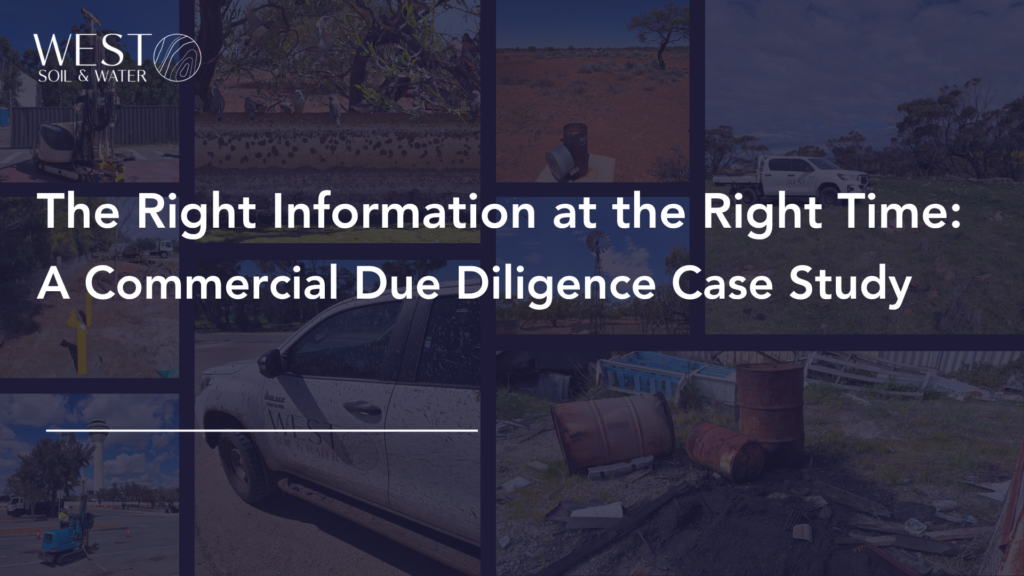
Due diligence rarely gives you the luxury of unlimited time. A client recently approached West Soil and Water about a commercial property they were considering purchasing. On paper, it was almost perfect! It was right size, right location, a relatively blank canvas for what they wanted to do with it. But there was a catch: the site had historically been used as a waste transfer station.
The client had already flagged the contamination risk through preliminary due diligence, and spoken with several environmental consultancies, who advised that a comprehensive investigation could take 12–16 weeks. Their due diligence period was 30 days, with the possibility of negotiating a further 30.
The real question wasn’t “Can we completely characterise this site in 30 days?”, rather it was: “What can we meaningfully understand in the time available, and how do we use that to help the client make their next decision?“
Start early, focus on what matters
Because the client came to us earlier than usual, it made a meaningful difference.
Our preliminary review suggested that understanding the site properly would likely require assessment of soil, asbestos and groundwater.
Rather than treating that as one large investigation, we developed a staged approach. Desktop work commenced immediately, followed quickly by a site inspection and this inspection changed the priorities.
Asbestos-containing material was visible at the ground surface, with signs that historical filling and mechanical spreading had distributed it more broadly across the site than anticipated. We shifted from a targeted investigation to a comprehensive, site-wide surface assessment and test-pitting program. The results confirmed buried fill material and asbestos impacts across the property.
A stop point, not a stop
That gave us our first meaningful stop point. A stop point doesn’t necessarily mean stopping. We sat down with the client and discussed what the findings actually meant for them. Not just that asbestos had been identified, but what management is needed? What could remediation involve? What might it cost? And does the property still make commercial sense?
The client decided they were comfortable factoring potential remediation into their negotiations. We connected them with contractors, provided fee estimates for the next stages, and gave them what they needed to support extending the due diligence period.
From there, each stage built on the last.
Chemical soil samples had been collected alongside the asbestos test-pitting works, avoiding unnecessary remobilisation. Groundwater monitoring bores were installed based on what the earlier work had revealed. Every stage gave the client another genuine opportunity to decide whether further spend was justified.
Informed decisions, not rushed ones
As of this article, we’re still working on this site. The deal may go ahead, or the client may walk away, but walking away from a property after properly understanding its environmental risk is very different from walking away because the process became too difficult; or purchasing it without understanding the liabilities that may come with it.
We couldn’t give this client every answer immediately. What we could give them was a clear pathway, built around their commercial timeframe: staging expenditure instead of asking for full commitment upfront, creating deliberate decision points as the risk picture became clearer, and leaning on good planning and strong contractor relationships to keep things moving.
That’s what our 3 R’s Reliable, Responsive and Resourceful mean to us in practice. Environmental due diligence isn’t just about producing a report; it’s about giving clients the right information at the right time to make a confident commercial decision. While finding the right property matters, finding a consultant who can help you understand it can matter just as much.